Genetika člověka
 Mikrobiologické aplikace
 NGS
 Rapid testy

 PCR plasty
 Pipetovací špičky
 Plasty pro buněčnou kultivaci
 Systém pro dlouhodobé skladování vzorků
 Zkumavky

 Třepačky
 Suché lázně
 Centrifugy
 End Point cyclery
 Real-time PCR cyclery
 Fluorometry
 Spektrofotometry
 Izolátory nukleových kyselin
 Pipetovací roboty
 Biobanking
 Live Cell Imaging

 Jednokanálové
 Multikanálové
 Sérologické pipety
 Jednorázové pipety

 Buněčné kultury
 PCR, qPCR, RT
 Detekce Mycoplasmat
 Reverzní transkripce

 Alergie
 Intolerance
 Elisa
 Imunologické analyzátory
 Veterinární imunologie
 Alergie u zvířat
 Intolerance u zvířat

 Čtečky identifikačních čipů
 Termočipy
 Biochemie
 Imunoanalýza


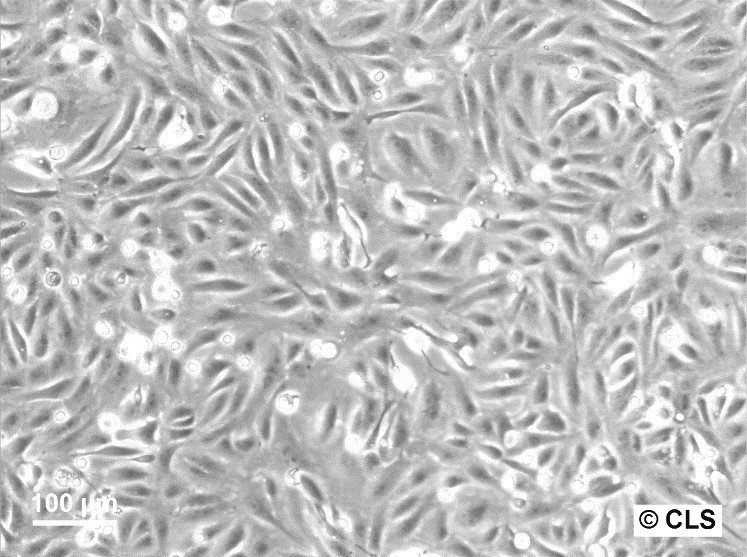

CV-1 Cells
| Unit |
3 x 10^6 cells/ml |
|---|---|
| Cell Type |
Immortalized Cells |
| Tissue Type |
Monkey cell lines |
| Organism |
Chlorocebus aethiops |
| Donor History | |
| Growth Properties |
Adherent |
| Growth Conditions |
Culture medium: EMEM (MEM Eagle) ,w: 2 mM L-Glutamine ,w: 2.2 g/L NaHCO3 ,w: EBSS (Cytion article number 820100a). Supplements: Supplement the medium with 10% FBS and 1% NEAA. Dissociation reagent: Accutase. Seeding density: 3 to 4 x 10⁴ cells/cm² will yield in a confluent layer in about 4 days. Freeze medium: As a cryopreservation medium ,we use complete growth medium (including FBS) + 10% DMSO for adequate post-thaw viability ,or CM-1 (Cytion catalog number 800100) ,which includes optimized osmoprotectants and metabolic stabilizers to enhance recovery and reduce cryo-induced stress. Incubation atmosphere: 37°C ,5% CO2 ,humidified atmosphere. |
| Immortalization Method | |
| Full Information |

CV-1 is a African green monkey cell line derived from the kidney in 1964. Initially used in research that focused on the transformation of the cancerogenic Rous sarcoma virus (RSV), this fibroblast-like cell line is widely used in biological research for virus production, transfection, and gene silencing.
These cells are negative for reverse transcriptase and being susceptible to several viruses, including poliovirus 1, herpes simplex, simian virus 40 (SV40), California encephalitis, and both Eastern and Western equine encephalitis.
The CV-1 cell line exhibits rapid growth, grows adherent on plastic and glass surfaces and shows chromosome number shifts at high passage levels. It has been observed that CV-1 cells exhibit increased tumorigenicity in Wistar rats treated with ATG as well as increased cell colony formation in soft agar.
Moreover, CV-1 cells support the replication of SV40 virus and exhibit rapid thymidine kinase (TK) activity following induction of simian, adeno, and papovavirus infections. The karyotype of CV-1 cells is 2n = 60, pseudodiploid.
CV-1 cells have been used in a variety of specific applications in biological research, including efficacy testing, transfection host, and viruscide testing. They are also known to be a suitable host for transfection, especially by SV40 vectors.
Společnost Cytion vznikla v roce 2004 v německém Heidelbergu s jasným vědeckým posláním: dodávat ověřené lidské a zvířecí buněčné linie bez kontaminace, připravené za přísně kontrolovaných laboratorních podmínek.
Postupně se vypracovala ve spolehlivou buněčnou banku, která slouží akademickým laboratořím, biotechnologickým firmám i farmaceutickým výzkumným týmům po celém světě. Klade přitom důraz na reprodukovatelnost výsledků, přísnou kontrolu kvality a dlouhodobá partnerství.