
 Genetika člověka
 Mikrobiologické aplikace
 NGS
 Rapid testy

 PCR plasty
 Pipetovací špičky
 Plasty pro buněčnou kultivaci
 Systém pro dlouhodobé skladování vzorků
 Zkumavky

 Třepačky
 Suché lázně
 Centrifugy
 End Point cyclery
 Real-time PCR cyclery
 Fluorometry
 Spektrofotometry
 Izolátory nukleových kyselin
 Pipetovací roboty
 Biobanking
 Live Cell Imaging

 Jednokanálové
 Multikanálové
 Sérologické pipety
 Jednorázové pipety

 Buněčné kultury
 PCR, qPCR, RT
 Detekce Mycoplasmat
 Reverzní transkripce

 Alergie
 Intolerance
 Elisa
 Imunologické analyzátory
 Veterinární imunologie
 Alergie u zvířat
 Intolerance u zvířat

 Čtečky identifikačních čipů
 Termočipy
 Biochemie
 Imunoanalýza


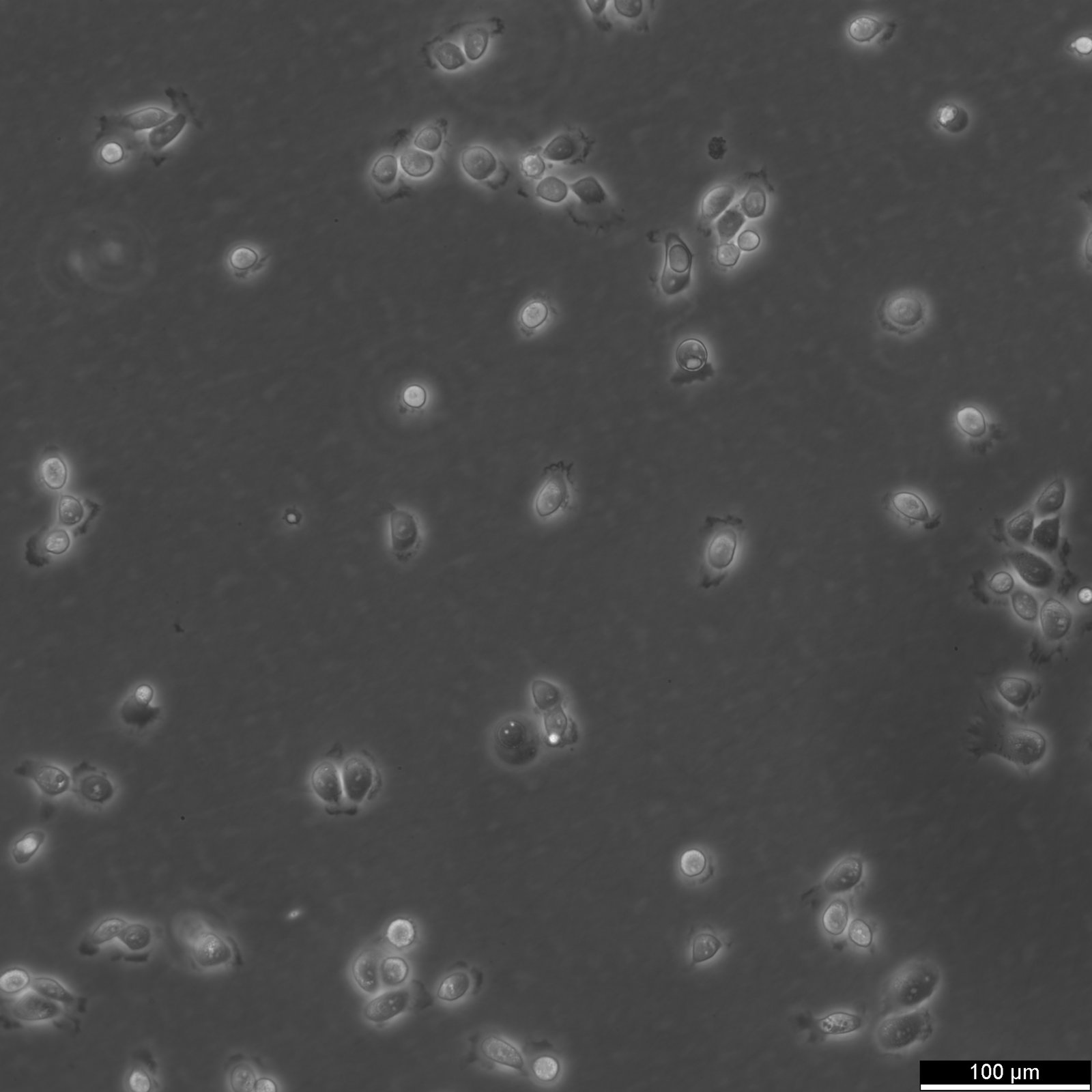

5637 Cells
| Unit |
3 x 10^6 cells/ml |
|---|---|
| Cell Type |
Tumor Cells |
| Tissue Type |
Urinary bladder cancer cell lines |
| Organism |
Human |
| Donor History |
Carcinoma |
| Growth Properties |
Adherent |
| Growth Conditions |
Culture medium: RPMI 1640 ,w: 2.0 mM stable Glutamine ,w: 2.0 g/L NaHCO3 (Cytion article number 820700a). Supplements: Supplement the medium with 10% FBS. Dissociation reagent: Accutase. Seeding density: 1 x 10⁴ cells/cm² will result in a confluent monolayer within 3 days. Freeze medium: As a cryopreservation medium ,we use complete growth medium (including FBS) + 10% DMSO for adequate post-thaw viability ,or CM-1 (Cytion catalog number 800100) ,which includes optimized osmoprotectants and metabolic stabilizers to enhance recovery and reduce cryo-induced stress. Incubation atmosphere: 37°C ,5% CO2 ,humidified atmosphere. |
| Immortalization Method | |
| Full Information |

5637 is a bladder carcinoma cell line isolated from the urinary bladder of a 68-year-old man with grade II carcinoma. 5637 cells produce and secrete several growth factors, such as SCF, IL-1, IL-6, G-CSF, and GM-CSF. These cytokines are functionally active and can be a valuable source for the culture of growth factor-responsive or dependent hematopoietic primary cells and cell lines.
The karyotype modal chromosome number of 5637 cells is 67, ranging from 59 to 71. The stemline modal chromosome number is 67 at 36% and polyploidy at 0.6%. Fourteen marker chromosomes are common to these cells, including 3q+, 11q+, i(13q), t(9q21q), i(17q), i(21q). Additional markers, like der(5)t(5;7)(q31;p11) and 1p, were only found specific to a minor subpopulation, as well as microchromosomes and double minutes (DM). Some cells include one or occasionally two Y chromosomes.
5637 cells are tumorigenic and have been shown to induce tumours in nude mice inoculated subcutaneously. The doubling time of 5637 cells is approximately 24 hours. The isoenzyme profile of 5637 cells consists of isoform 1 of AK-1, ES-D, Me-2 and PGM1, isoform 1 and 2 of GLO-I, isoform B of G6PD, as well as isoform 2 of PGM3.
In terms of oncogenes, 5637 cells are positive for FGFR3, PIK3CA, HRAS, KRAS, NRAS, TERT, and CDKN2A but negative for TP53 and belong to the molecular bladder cancer subtype l5637 is a bladder carcinoma cell line isolated from the urinary bladder of a 68-year-old man with grade II carcinoma. 5637 cells produce and secrete several growth factors, such as SCF, IL-1, IL-6, G-CSF, and GM-CSF. These cytokines are functionally active and can be a valuable source for the culture of growth factor-responsive or dependent hematopoietic primary cells and cell lines.
The karyotype modal chromosome number of 5637 cells is 67, ranging from 59 to 71. The stemline modal chromosome number is 67 at 36% and polyploidy at 0.6%. Fourteen marker chromosomes are common to these cells, including 3q+, 11q+, i(13q), t(9q21q), i(17q), i(21q). Additional markers, like der(5)t(5;7)(q31;p11) and 1p, were only found specific to a minor subpopulation, as well as microchromosomes and double minutes (DM). Some cells include one or occasionally two Y chromosomes.
5637 cells are tumorigenic and have been shown to induce tumours in nude mice inoculated subcutaneously. The doubling time of 5637 cells is approximately 24 hours. The isoenzyme profile of 5637 cells consists of isoform 1 of AK-1, ES-D, Me-2 and PGM1, isoform 1 and 2 of GLO-I, isoform B of G6PD, as well as isoform 2 of PGM3.
In terms of oncogenes, 5637 cells are positive for FGFR3, PIK3CA, HRAS, KRAS, NRAS, TERT, and CDKN2A but negative for TP53 and belong to the molecular bladder cancer subtype luminal.
In conclusion, 5637 cells are a valuable tool for cancer research, especially with respect to the study of growth factors, cell division, oncogenes, and bladder cancer.
Společnost Cytion vznikla v roce 2004 v německém Heidelbergu s jasným vědeckým posláním: dodávat ověřené lidské a zvířecí buněčné linie bez kontaminace, připravené za přísně kontrolovaných laboratorních podmínek.
Postupně se vypracovala ve spolehlivou buněčnou banku, která slouží akademickým laboratořím, biotechnologickým firmám i farmaceutickým výzkumným týmům po celém světě. Klade přitom důraz na reprodukovatelnost výsledků, přísnou kontrolu kvality a dlouhodobá partnerství.