Genetika člověka
 Mikrobiologické aplikace
 NGS
 Rapid testy

 PCR plasty
 Pipetovací špičky
 Plasty pro buněčnou kultivaci
 Systém pro dlouhodobé skladování vzorků
 Zkumavky

 Třepačky
 Suché lázně
 Centrifugy
 End Point cyclery
 Real-time PCR cyclery
 Fluorometry
 Spektrofotometry
 Izolátory nukleových kyselin
 Pipetovací roboty
 Biobanking
 Live Cell Imaging

 Jednokanálové
 Multikanálové
 Sérologické pipety
 Jednorázové pipety

 Buněčné kultury
 PCR, qPCR, RT
 Detekce Mycoplasmat
 Reverzní transkripce

 Alergie
 Intolerance
 Elisa
 Imunologické analyzátory
 Veterinární imunologie
 Alergie u zvířat
 Intolerance u zvířat

 Čtečky identifikačních čipů
 Termočipy
 Biochemie
 Imunoanalýza


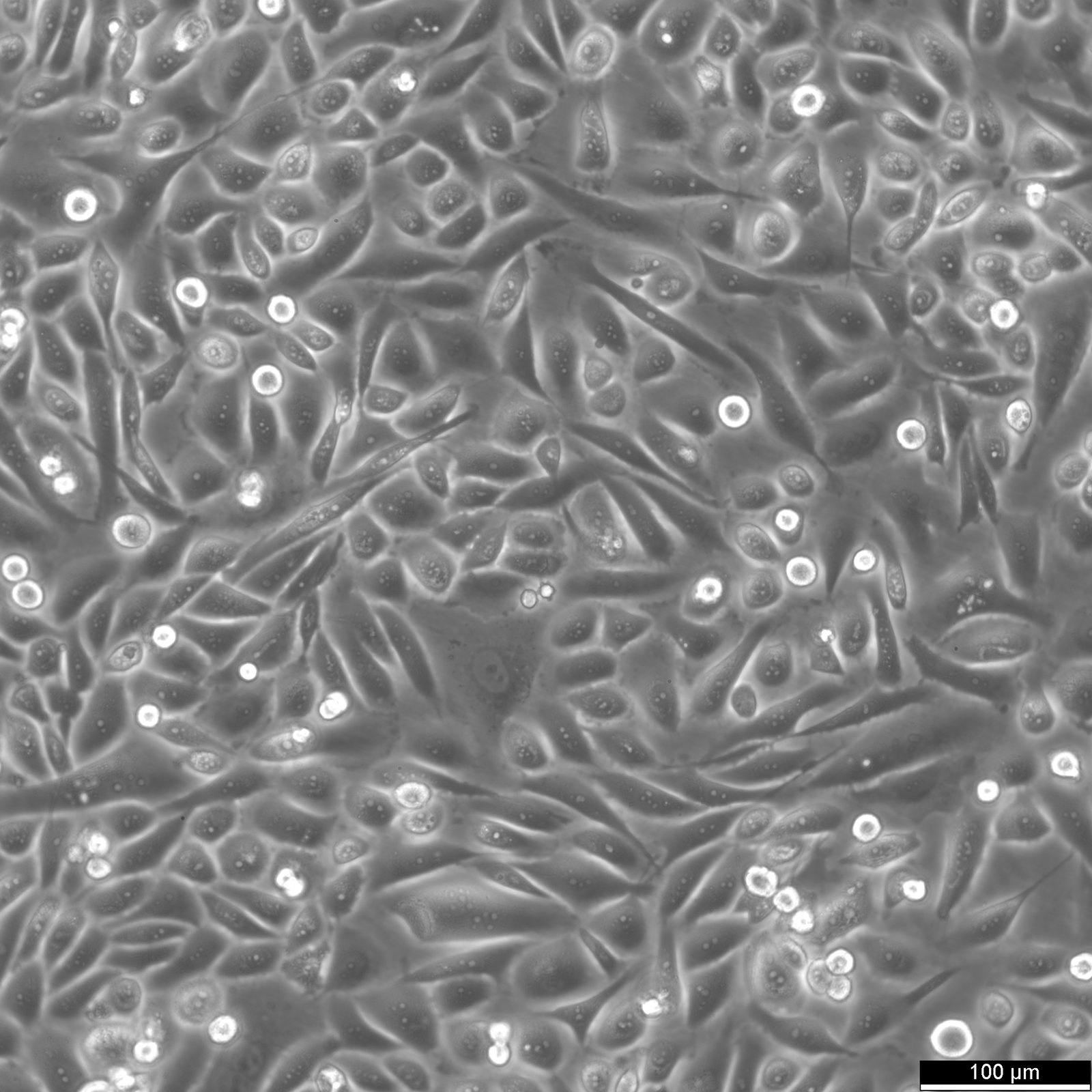

PC-3 Cells
| Unit |
3 x 10^6 cells/ml |
|---|---|
| Cell Type |
Tumor Cells |
| Tissue Type |
Prostate cancer cell lines |
| Organism |
Human |
| Donor History |
Adenocarcinoma |
| Growth Properties |
Adherent. The cells form clusters in soft agar and can be adapted to suspension growth |
| Growth Conditions |
Culture medium: DMEM:Ham's F12 (1:1) ,w: 3.1 g/L Glucose ,w: 2.5 mM L-Glutamine ,w: 15 mM HEPES ,w: 0.5 mM Sodium pyruvate ,w: 1.2 g/L NaHCO3 (Cytion article number 820400a). Supplements: Supplement the medium with 5% FBS. Dissociation reagent: Accutase. Seeding density: Start with 3 x 10⁴ cells/cm². After cell recovery ,use the seeding density of 1 x 10⁴ cells/cm² for the subsequent splitting steps. Freeze medium: As a cryopreservation medium ,we use complete growth medium (including FBS) + 10% DMSO for adequate post-thaw viability ,or CM-1 (Cytion catalog number 800100) ,which includes optimized osmoprotectants and metabolic stabilizers to enhance recovery and reduce cryo-induced stress. Incubation atmosphere: 37°C ,5% CO2 ,humidified atmosphere. |
| Immortalization Method | |
| Full Information |

PC3 cells, derived from the bone metastasis in a 62-year-old Caucasian male with grade IV prostatic adenocarcinoma, are a cornerstone in the study of human prostate carcinoma. The PC-3 human prostate cancer cell line is widely used for studying the molecular and cellular aspects of prostate cancer, especially in the context of metastatic disease. Their high metastatic potential makes them a valuable model for advanced prostate cancer research.
As epithelial cells, PC3 cells’ lack of response to androgens and their independence from typical growth factors like glucocorticoids or fibroblast growth factors, positions them uniquely among human prostate carcinoma cells for studying the impact of koenimbin and other potential therapeutic agents.
The absence of prostate-specific antigen (PSA) expression and low activities of testosterone-5-alpha reductase and acidic phosphatase set PC3 apart from other prostate cancer cell models like LNCaP and DU145, the former known for expressing luminal differentiation markers such as AR and PSA, and the latter representing a moderated metastatic potential of prostate carcinoma.
Furthermore, the role of the PC3 prostatic carcinoma cell line in prostate cancer stem cells research is underscored by the observation that a subset forms cancer stem cell holoclones. This characteristic makes the PC3 cell line a critical model for studying the tumor environment, particularly through xenograft models where PC3 xenograft tumors are used to investigate tumor growth and response to therapies in vivo.
In summary, PC3 cells, originating from a grade IV prostatic adenocarcinoma, serve as a pivotal model in prostate cancer research due to their high metastatic potential, unique androgen independence, and distinct cellular characteristics. Their versatility extends from molecular studies of metastasis to the exploration of therapeutic responses and the investigation of prostate cancer stem cells, making them an invaluable resource for advancing our understanding of prostate carcinoma’s complexities and potential treatments.
Společnost Cytion vznikla v roce 2004 v německém Heidelbergu s jasným vědeckým posláním: dodávat ověřené lidské a zvířecí buněčné linie bez kontaminace, připravené za přísně kontrolovaných laboratorních podmínek.
Postupně se vypracovala ve spolehlivou buněčnou banku, která slouží akademickým laboratořím, biotechnologickým firmám i farmaceutickým výzkumným týmům po celém světě. Klade přitom důraz na reprodukovatelnost výsledků, přísnou kontrolu kvality a dlouhodobá partnerství.