
 Genetika člověka
 Mikrobiologické aplikace
 NGS
 Rapid testy

 PCR plasty
 Pipetovací špičky
 Plasty pro buněčnou kultivaci
 Systém pro dlouhodobé skladování vzorků
 Zkumavky

 Třepačky
 Suché lázně
 Centrifugy
 End Point cyclery
 Real-time PCR cyclery
 Fluorometry
 Spektrofotometry
 Izolátory nukleových kyselin
 Pipetovací roboty
 Biobanking
 Live Cell Imaging

 Jednokanálové
 Multikanálové
 Sérologické pipety
 Jednorázové pipety

 Buněčné kultury
 PCR, qPCR, RT
 Detekce Mycoplasmat
 Reverzní transkripce

 Alergie
 Intolerance
 Elisa
 Imunologické analyzátory
 Veterinární imunologie
 Alergie u zvířat
 Intolerance u zvířat

 Čtečky identifikačních čipů
 Termočipy
 Biochemie
 Imunoanalýza


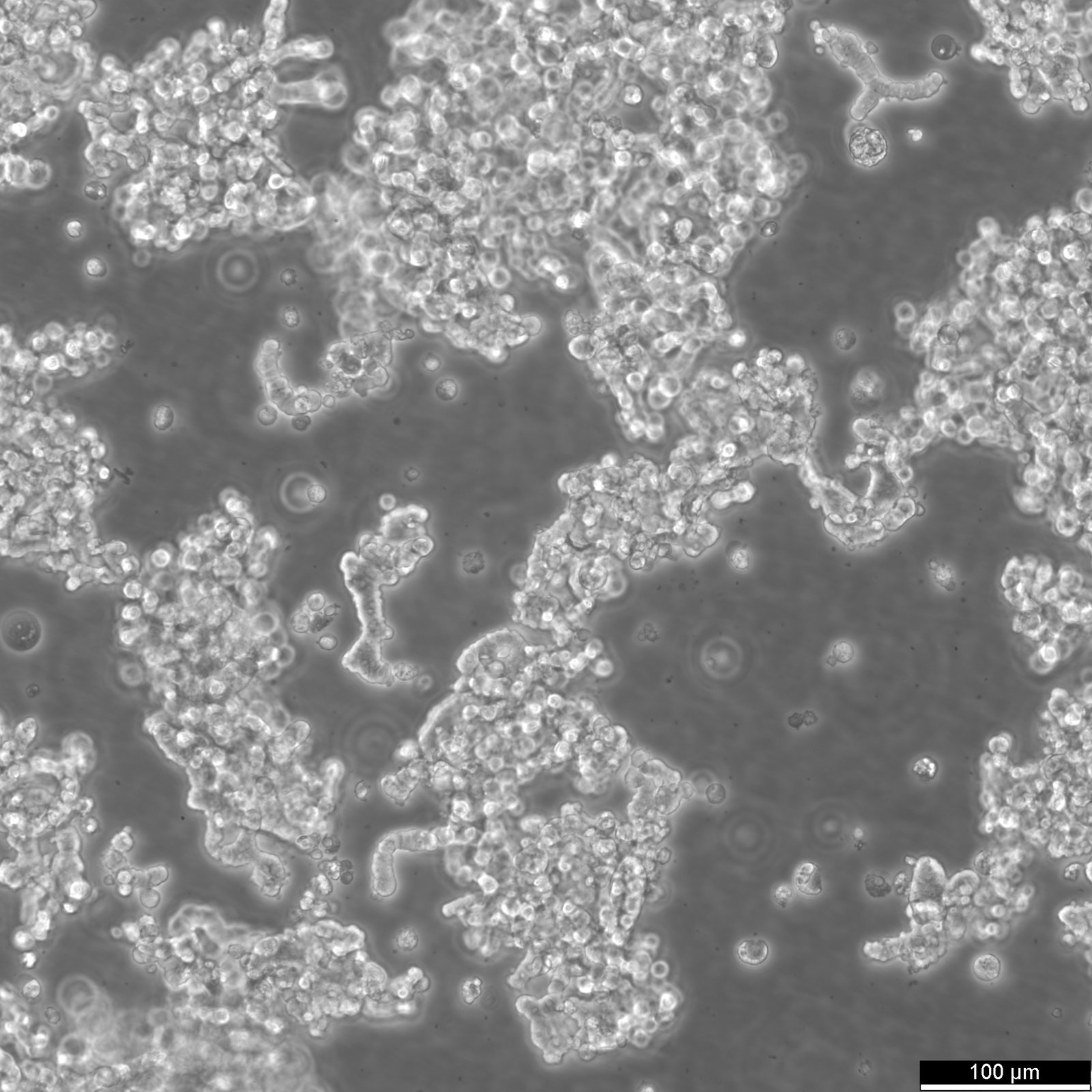

SCLC-21H Cells
| Unit |
5 x 10^6 cells/ml |
|---|---|
| Cell Type |
Tumor Cells |
| Tissue Type |
Lung cancer cell lines |
| Organism |
Human |
| Donor History |
Carcinoma |
| Growth Properties |
Suspension |
| Growth Conditions |
Culture medium: RPMI 1640 ,w: 2.0 mM stable Glutamine ,w: 2.0 g/L NaHCO3 (Cytion article number 820700a). Supplements: Supplement the medium with 10% heat-inactivatedFBS. Dissociation reagent: Accutase. Seeding density: 2 to 4 x 10⁴ cells/cm². Freeze medium: As a cryopreservation medium ,we use 50% basal medium + 40% FBS + 10% DMSO ,or CM-1 (Cytion catalog number 800100) ,which includes optimized osmoprotectants and metabolic stabilizers to enhance recovery and reduce cryo-induced stress. Incubation atmosphere: 37°C ,5% CO2 ,humidified atmosphere. |
| Immortalization Method | |
| Full Information |

The SCLC-21H cell line was derived from the pleural effusion of a patient with small cell lung cancer (SCLC) of the oat cell subtype. This cell line, along with SCLC-22H, was established during a period of chemotherapy, with SCLC-21H being the second to be derived after an additional 15 days of treatment. While both cell lines originated from the same patient, they display significantly different biochemical, morphological, and kinetic properties. SCLC-21H, for example, has a faster population doubling time and a higher colony-forming efficiency compared to SCLC-22H. These differences make SCLC-21H a distinct tool for studying certain variant forms of SCLC.
Biochemically, SCLC-21H differs from SCLC-22H in its low or undetectable levels of key neuroendocrine markers such as L-Dopa decarboxylase, bombesin, and carcinoembryonic antigen. However, both cell lines express high levels of neuron-specific enolase and creatine kinase isoenzyme BB, which are characteristic markers of SCLC. Moreover, while both cell lines exhibit c-myc amplification, SCLC-21H contains an additional rearranged and amplified EcoRI c-myc fragment, further highlighting its genetic uniqueness.
Structurally, SCLC-21H exhibits loose growth in culture and features prominent nucleoli and abundant cytoplasm, contrasting with the more tightly packed morphology of SCLC-22H. The presence of ultrastructurally dense core granules in SCLC-21H confirms its neuroendocrine origin, and it is classified as representing a variant form of SCLC. These distinct features make SCLC-21H a valuable model for exploring the variant forms of small cell lung cancer and understanding their response to chemotherapy.
Společnost Cytion vznikla v roce 2004 v německém Heidelbergu s jasným vědeckým posláním: dodávat ověřené lidské a zvířecí buněčné linie bez kontaminace, připravené za přísně kontrolovaných laboratorních podmínek.
Postupně se vypracovala ve spolehlivou buněčnou banku, která slouží akademickým laboratořím, biotechnologickým firmám i farmaceutickým výzkumným týmům po celém světě. Klade přitom důraz na reprodukovatelnost výsledků, přísnou kontrolu kvality a dlouhodobá partnerství.